Strength Training for Busy Founders: The 3-Day Plan That Actually Sticks
You don't need six days a week or a home gym. Three 45-minute dumbbell sessions built more muscle. And more energy. Than any cardio routine I ever tried.
Relevant ads will appear here once AdSense is connected.
For years my exercise plan was "run when guilty." I'd do nothing for three weeks, then punish myself with a 10K on Sunday and spend Monday limping around the office. My cardio fitness went up and down like a startup's revenue chart. My strength went nowhere. At 34, I noticed I was getting winded carrying groceries up two flights of stairs, and that embarrassed me more than any failed product launch.
Then I read the 2026 Life Time wellness survey: 42.3% of respondents named building strength their top fitness goal, and 33.2% said longevity was their main motivation for exercising. The cultural tide had turned while I wasn't looking. Strength training had quietly become the thing smart, busy people do. So I hired a coach for exactly one month, learned the basics, and built the simplest program that the research supports. Eighteen months later, I'm still doing it. Here's the whole thing.
A quick note before we start: this is general fitness information from my own experience, not medical advice. If you have a heart condition, joint problems, or pain that doesn't resolve, talk to a doctor or physiotherapist before lifting. And get a trainer to check your form for one session. It's the best $50 in fitness you'll ever spend.
1. Why strength beats cardio for founders
Cardio is great for your heart, but strength training is the highest-leverage exercise a busy person can do. Muscle is metabolically expensive tissue. It burns calories at rest, stabilizes your joints, protects your bones, and keeps your blood sugar steadier through long desk days. After age 30, adults lose 3–8% of muscle mass per decade without resistance training. That loss is called sarcopenia, and it's the reason people in their 50s start struggling with stairs. You can't outsource this one later; the muscle you build in your 30s and 40s is a retirement account for your body.
For founders specifically, strength training has a hidden benefit: it's the only workout that fits a chaotic schedule. A run needs decent weather and a route. A gym session needs a commute. Dumbbells in the corner of your bedroom need nothing except 45 minutes and a floor. I do mine at 7 a.m. Before the day's first fire starts, and no meeting has ever been scheduled at 7 a.m.. That's the whole scheduling strategy.
2. The minimum effective dose: 3 days, 45 minutes
Here's the number that changed everything for me: research consistently shows that training each muscle group twice per week captures the vast majority of muscle-growth benefits. A third weekly session adds a bit more; a fourth and fifth add almost nothing for a beginner. That means three full-body sessions per week is not a compromise. It's close to the optimal dose for someone who also runs a company.
Each session is 45 minutes: 5 minutes of warm-up (arm circles, bodyweight squats, a brisk walk in place), 35 minutes of lifting, 5 minutes of stretching. I do Monday, Wednesday, Friday. If a week explodes and I miss Friday, I do Saturday. The rule is three sessions per seven-day window, not specific days. In eighteen months I've missed maybe ten sessions total, which is an adherence rate my old running habit never came close to. Consistency at 80% beats perfection at 0%.
3. The equipment: less than you think
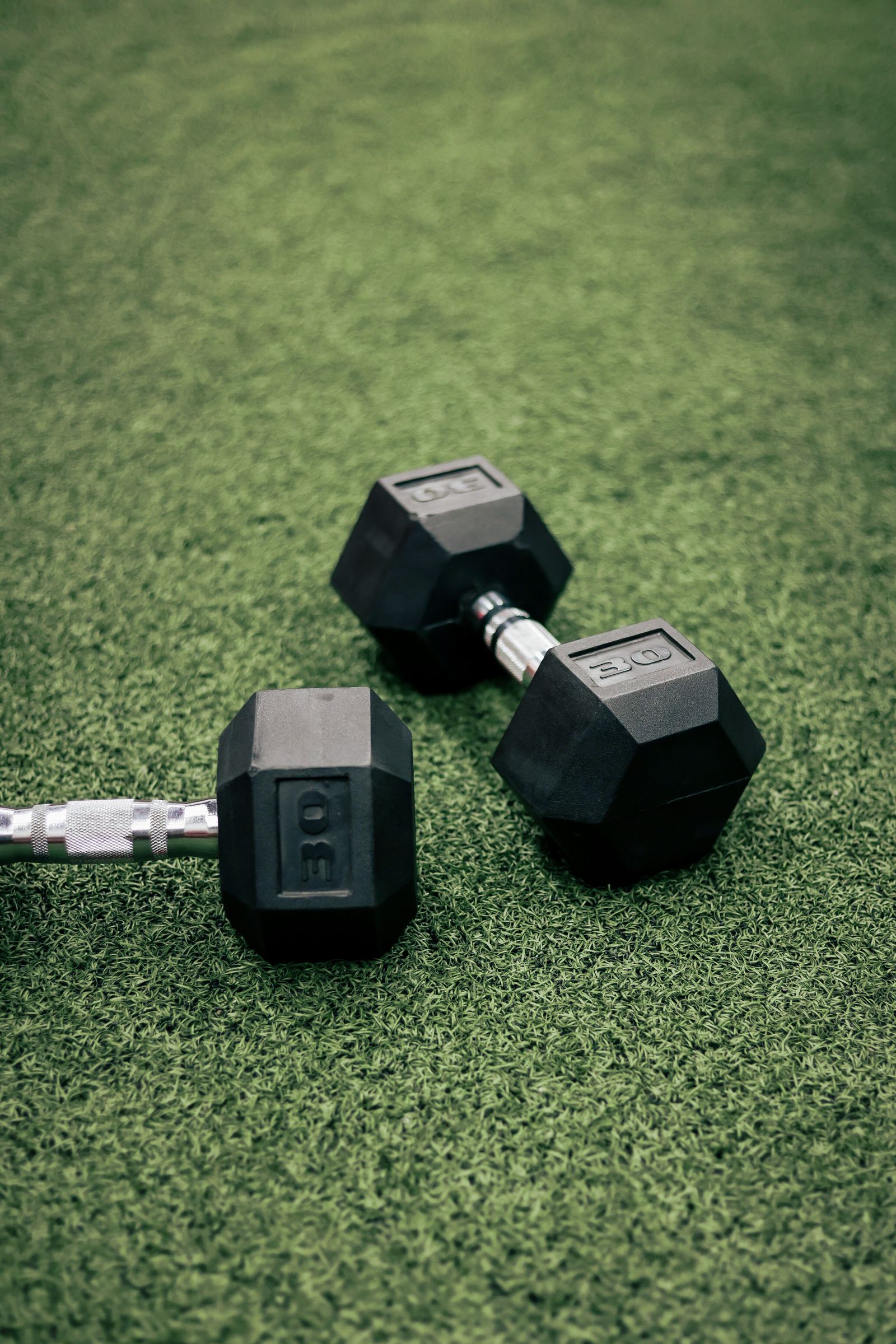
You need one pair of adjustable dumbbells. That's it. A fixed set works too, but adjustable ones (the kind that go from 2.5 to 24 kg per hand) cover your first two years of progress and take up less space than a shoebox. A flat bench is nice for chest presses but optional. Floor presses work fine. Total cost: roughly $100–200 for a decent adjustable pair, which is less than two months of most gym memberships.
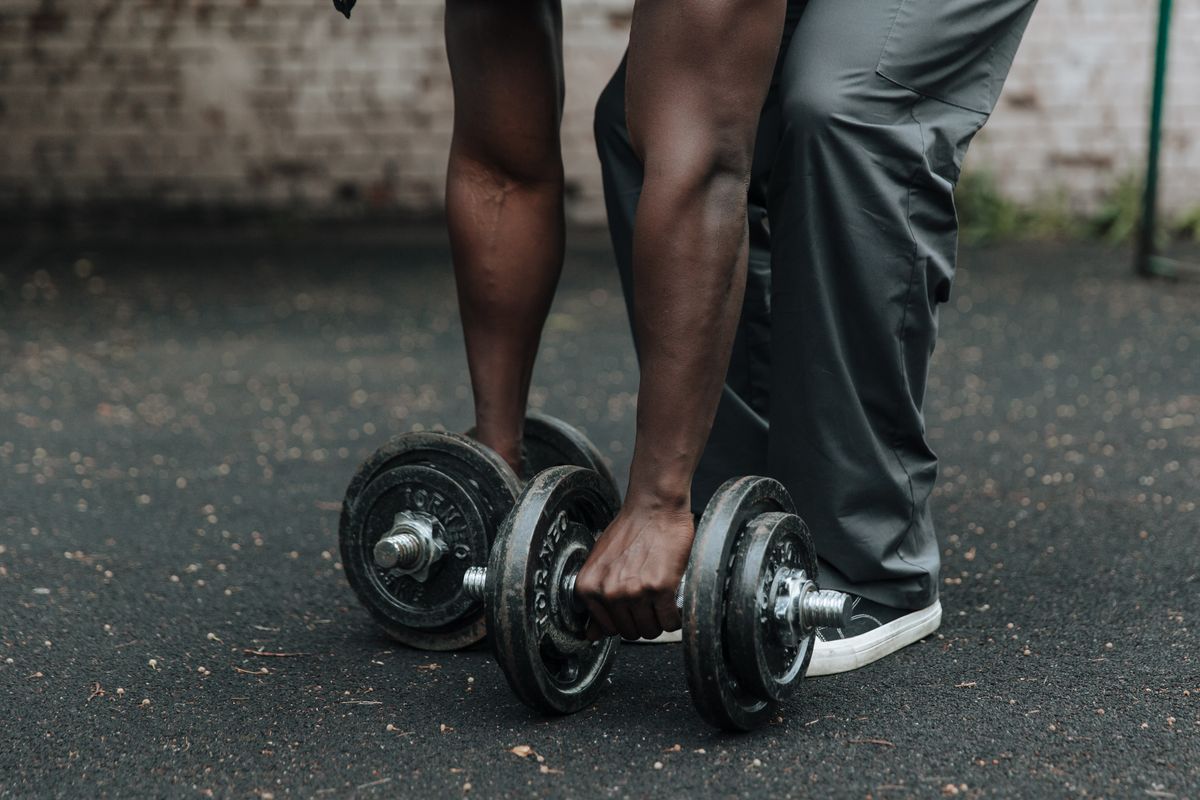
Where to put them matters more than which brand. Mine live in the corner of my bedroom, visible from the bed. Visible equipment gets used; equipment in a closet is decoration. If you travel constantly, a pair of resistance bands in your suitcase covers the same movement patterns badly but better than nothing. And "better than nothing" is the whole philosophy here.
4. The 3-day dumbbell plan
The plan rotates two full-body workouts, A and B. Week one is A-B-A, week two is B-A-B, and so on. Every exercise is 3 sets of 8–12 reps, resting 60–90 seconds between sets. Pick a weight where the last two reps of each set feel hard but your form stays clean. If you can do 12 reps on all three sets with good form, go heavier next time. That's the entire progression system, and it works for years.
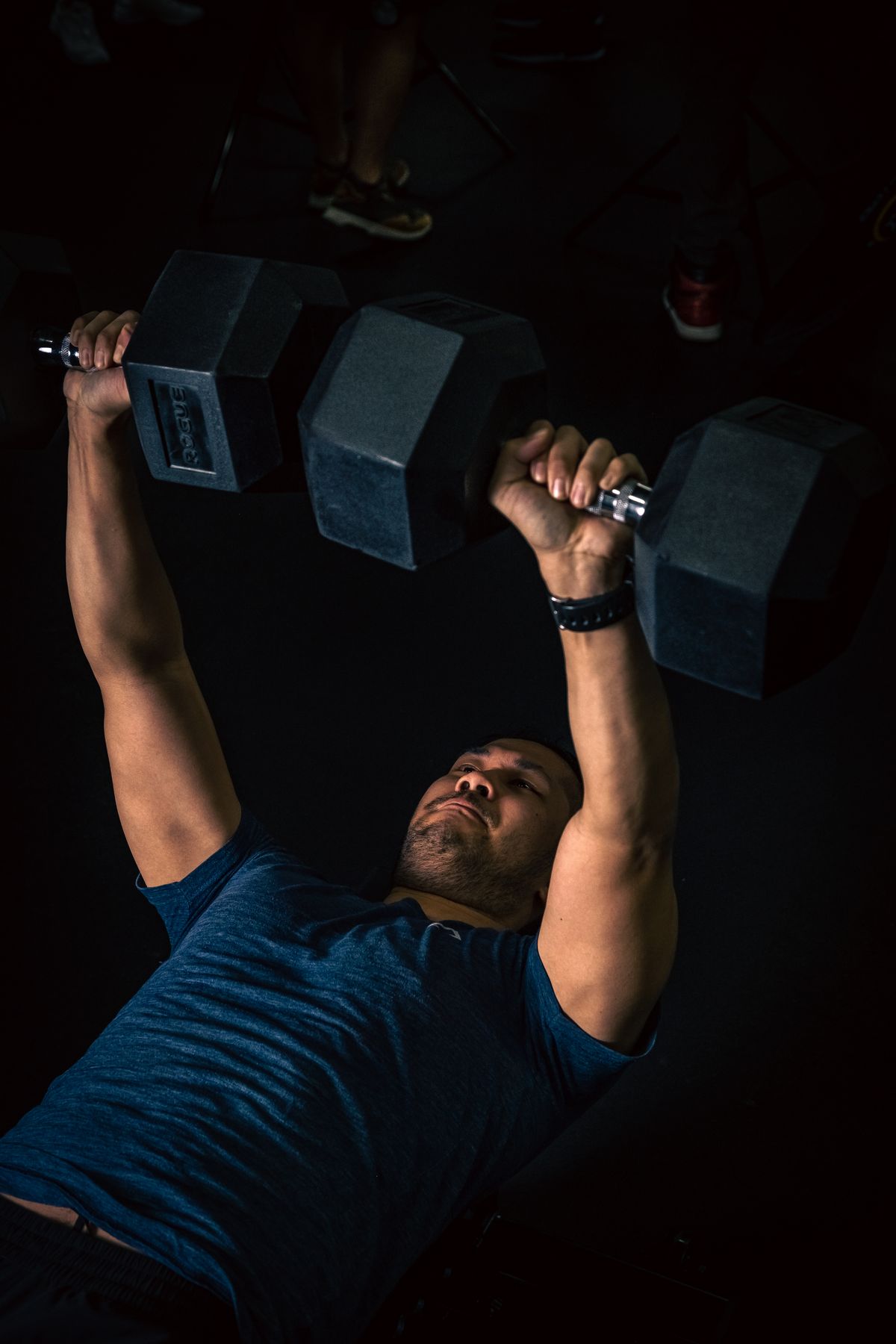
Workout A: push + legs
Goblet squats. Hold one dumbbell at your chest, squat until your thighs are parallel to the floor. 3 × 8–12. This is the king of beginner leg exercises: it teaches upright posture automatically because the weight pulls you forward if you lean.
Dumbbell floor press. Lie on your back, knees bent, press both dumbbells from chest to straight arms. 3 × 8–12. The floor stops your elbows at a safe depth, which makes this joint-friendly for beginners.
Standing overhead press. Press both dumbbells from shoulders to overhead, bracing your core like someone's about to poke your stomach. 3 × 8–12. Keep your ribs down; don't lean back.
Bent-over rows. Hinge at the hips, back flat, pull both dumbbells to your ribs. 3 × 8–12. Think of squeezing a pencil between your shoulder blades at the top.
Workout B: pull + legs + core
Romanian deadlifts. Hold dumbbells in front of your thighs, push your hips back, lower to mid-shin with a flat back, stand up by driving your hips forward. 3 × 8–12. This builds the glutes and hamstrings that desk work lets waste away. Start light. Form first, always.
Single-arm rows. One knee and hand on a chair or bed, row the dumbbell to your hip. 3 × 8–12 each side. The best back builder in the dumbbell world.
Reverse lunges. Step backward into a lunge, alternating legs. 3 × 8–12 per leg. Easier on the knees than forward lunges and great for balance.
Farmer's carries. Pick up the heaviest dumbbells you can hold and walk for 40 seconds. 3 rounds. Grip, core, traps, and conditioning in one brutally simple package. I do these in my hallway and my neighbors think I'm moving furniture.
5. How to progress without a trainer
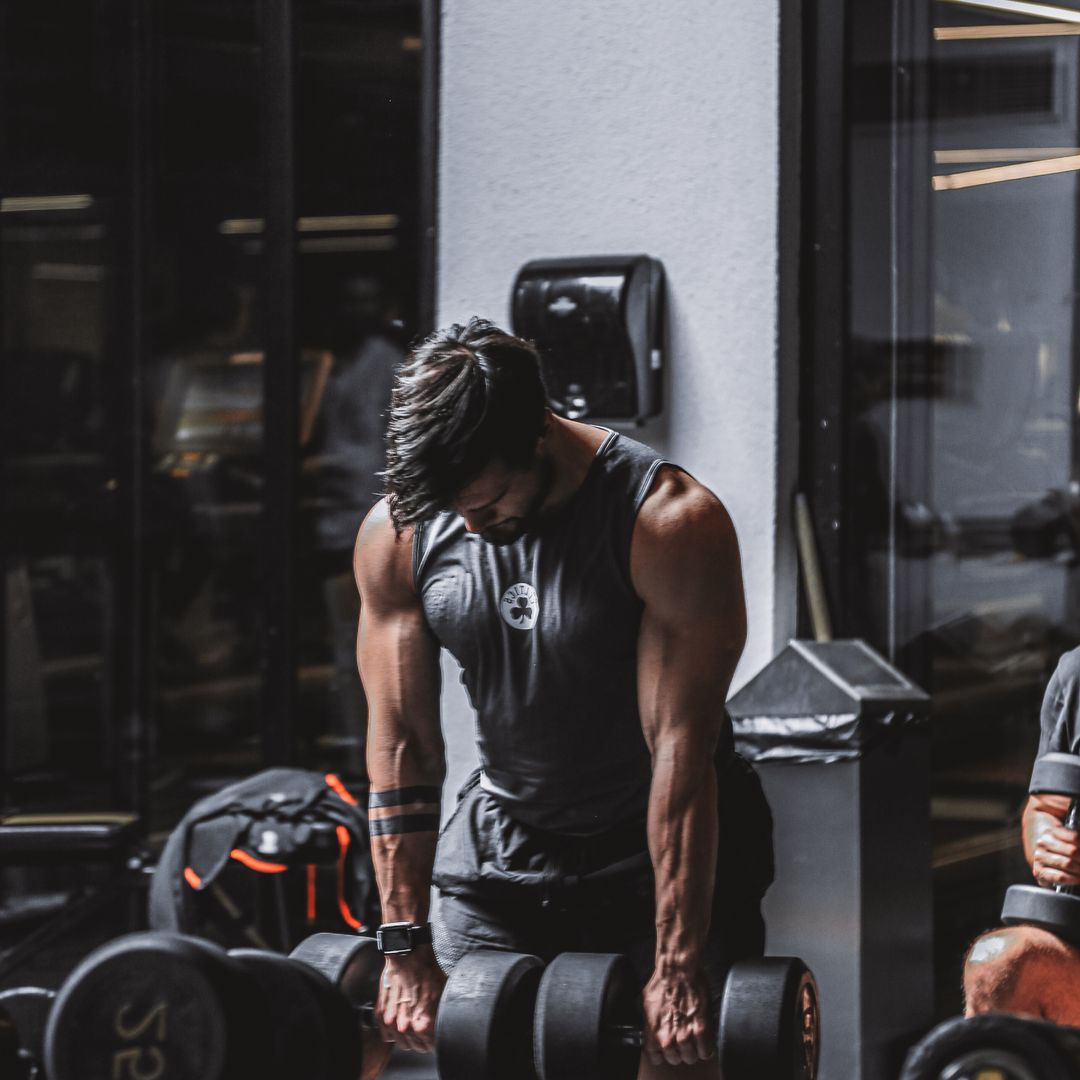
Muscles grow when you ask them to do slightly more than they're used to. A principle called progressive overload. You don't need an app or a spreadsheet. Use double progression: first add reps, then add weight. If your target is 3 × 8–12 and you hit 3 × 12 on goblet squats with 15 kg, move to 17.5 kg next session, where you'll probably manage 3 × 8. Build back to 3 × 12, then move up again. Repeat forever.
Expect fast progress for 3–6 months (beginner gains are real and wonderful), then slower progress. That's normal, not a plateau to panic about. What matters is the trend over months. I keep a paper notebook by the dumbbells. Date, exercise, weight, reps. Thirty seconds of logging per session, and it turns "am I getting stronger?" from a feeling into a fact.
When progress stalls on a lift for three weeks, don't add a fourth training day. Instead: eat a bit more protein, sleep a bit more (see our founder's sleep protocol), and check whether life stress is up. Nine times out of ten, a "plateau" is just an under-recovered founder.
6. Eat like someone who lifts
You don't need a meal plan. You need enough protein: roughly 1.6 grams per kilogram of body weight per day for someone lifting three times a week. For a 75 kg founder, that's 120 grams. In practice: a palm-sized portion of protein at each meal, plus one protein-rich snack. Eggs at breakfast, chicken/fish/lentils at lunch and dinner, Greek yogurt or a shake as a snack. Done.
Two things I learned the hard way. First, eat a real meal within a couple of hours after training. I trained fasted for months and my progress was noticeably slower than after I started having lunch post-workout. Second, don't try to lose fat and build muscle aggressively at the same time as a beginner founder. Pick one goal for 12 weeks. Most desk workers should pick building muscle; the fat loss follows when your metabolism has more muscle to feed.
| Approach | Time per week | Muscle built (beginner year) | Adherence reality |
|---|---|---|---|
| 3-day dumbbell plan (this post) | 2.25 hours | High. Hits every muscle 1.5×/week | Very high; fits any schedule |
| 5-day body-part split | 5–7 hours | Slightly higher, in theory | Low for founders; one bad week kills it |
| Daily running only | 3–4 hours | Near zero; may lose muscle | Medium; weather and knees interfere |
| Random YouTube workouts | 2–3 hours | Low. No progression system | Medium; novelty fades in a month |
Relevant ads will appear here once AdSense is connected.
FAQ
Am I too old to start strength training?
No. Adults in their 60s and 70s build measurable muscle and bone density with resistance training. Starting at 35 or 45 puts you ahead of nearly everyone. The best time was at 20, the second-best time is this week.
Will lifting make me bulky?
Getting visibly bulky takes years of dedicated heavy training plus a calorie surplus. Three 45-minute dumbbell sessions will make you look athletic and move better, not like a bodybuilder. This fear stops more people than any injury ever has.
Should I be sore after every workout?
No. Soreness signals novelty, not progress. You'll be sore for the first 2–3 weeks, then it fades as your body adapts. While you keep getting stronger. Chasing soreness leads to junk volume and injuries.
Do I need a gym, or are home dumbbells enough?
Home dumbbells are enough for the first 1–2 years. You'll eventually want heavier weights for deadlifts and rows, at which point a gym membership or heavier adjustable set makes sense. Don't let equipment be the excuse that delays month one.
How fast will I see results?
Strength improves in 2–4 weeks (mostly your nervous system learning). Visible muscle changes take 8–12 weeks. Take a photo on day one in the same lighting. The mirror lies daily, but month-three photos don't.
Do I still need cardio?
Yes, but less than you think. Two or three 20–30 minute easy sessions per week (brisk walking counts) cover heart health. Our Zone 2 cardio guide explains the lowest-effort way to do it.
Start this week, not next month
Here's your assignment: order adjustable dumbbells today, and do Workout A with bodyweight only tomorrow morning. Bodyweight squats, push-ups, a plank. No equipment needed for session one. When the dumbbells arrive, you're already in the habit. Eighteen months from now you'll either be the founder who lifts or the founder who kept meaning to. The difference is one 45-minute session, done imperfectly, this week.
More in Health: how I walked 9,000 steps a day with a desk job. The perfect active-recovery companion to lifting days.
Relevant ads will appear here once AdSense is connected.